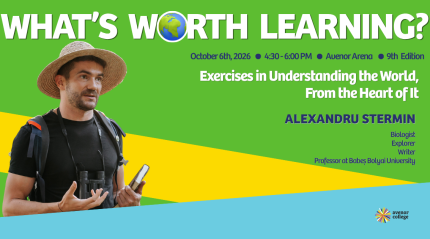
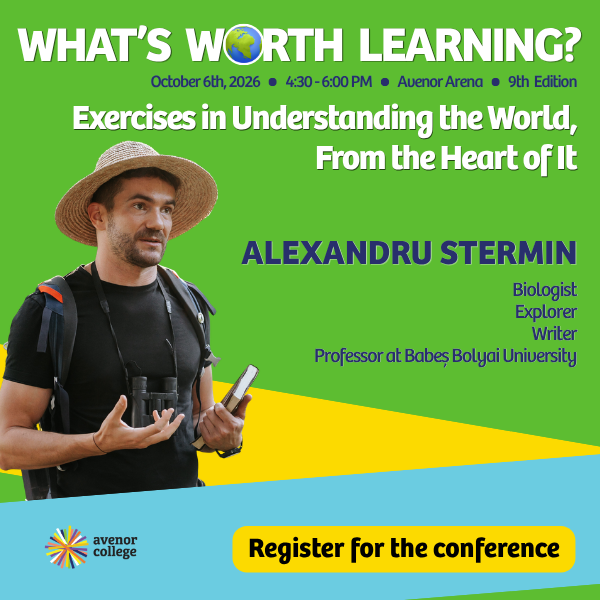
At Avenor, we nurture curious children and cultivate critical thinking as an essential tool for navigating a world in constant change. The 8th edition of the “What’s Worth Learning?” conference, themed “The Future: Between Anticipation and Preparation”, once again confirmed that the direction we are taking is both relevant and necessary.
In a context shaped by technological acceleration, artificial intelligence and an overwhelming flow of information, the discussions during the conference highlighted the importance of skills that Avenor students already practise every day: critical thinking, the ability to make connections, responsibility, and a strong sense of identity.
 “The future is already here, but it is not always visible or understood,” emphasised Dragoș Stanca, founder of the Ethical Media Alliance, as he explained the accelerating pace of technological change and its impact on democracy, information and childhood. He illustrated how technological progress can no longer be perceived in linear terms: ten ordinary steps in daily life translate into more than a kilometre in technology. The pace is no longer exponential, but “super-exponential”, and developments in artificial intelligence, robotics, biotechnology and quantum computing are not happening sequentially, but simultaneously.
This reality brings innovation, but also confusion, anxiety and growing generational gaps.
“Scrolling is the new smoking,” Stanca added, pointing out that today’s digital ecosystem is built efficiently, but not ethically. Children are growing up in an environment where their attention is a commodity, and algorithms reward extreme emotion and polarisation rather than truth or the public good. The message is clear: it is no longer enough to protect children. We must teach them to understand how platforms work and to consume information with a critical eye.

“What if we taught the future in school?” challenged Diana Stafie, strategic foresight consultant and founder of Future Station. The concept of future literacy encourages us to explore possible scenarios, use imagination and develop transdisciplinary thinking — exactly what we do at Avenor through integrated projects and an applied curriculum. One concrete exercise that resonated strongly with parents was that of “memories from the future”: before making a decision, children are encouraged to imagine possible outcomes. This helps reduce anxiety and supports more conscious, responsible decision-making.
The conference reaffirmed that Avenor’s pedagogy — centred on critical thinking, autonomy, responsibility and character — is not only relevant, but essential. At the same time, it offered new perspectives: how to talk meaningfully about the impact of technology, how to prepare children for uncertainty, and how to develop their capacity to be active participants in the world, rather than passive spectators.
future is not just something that happens to us; it is something we can shape and co-create through engagement,” Diana Stafie concluded.
The conference was therefore not only a space for dialogue, but also a powerful reminder that education is not about prediction, but about preparing children to think, adapt and actively contribute to the world of tomorrow.