We have become so used to seeing children holding phones that it barely surprises us anymore. A 10–12-year-old with eyes fixed on a screen in every spare moment of the day has become the norm.
At Avenor, phones are not part of that norm. Students do not use them during the school day. If they bring them, they leave them at the entrance in a specially designated locker. Throughout the day, technology is used through school-managed devices, with controlled access and educationally validated applications. The goal is not rigid control, but protecting the learning environment and students’ well-being.
And yet, even within a regulated framework, digital reality remains present. Children live in a world where access to social media is just one click away outside of school. That is why the question is not only whether we ban it, but how we prepare them for the moment when we will no longer be able to control access.
Because beyond rules, we all play a role in this equation — school, parents, and society as a whole.
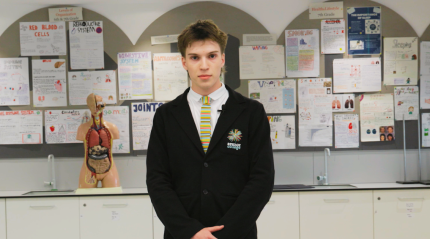
Victor Bratu, EdTech and Data Lead at Avenor College, speaks in this article about our shared responsibility.
Social Media Is Not “Just Another App”
 For children and teenagers, social media is an environment designed to capture attention, amplify social comparison, and turn validation into currency.
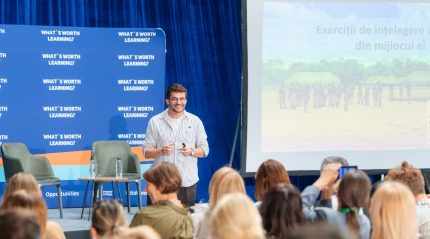
At the conference “What`s Worth Learning?”, Dragoș Stanca, founder of Ethical Media Alliance, addressed this reality directly: we live in a digital ecosystem built for efficiency and profit, not for balance or social good.
“Only 3.5% of the content reaching people today is in the public interest. The rest is noise,” he said.
In this model, attention becomes the product. Children are not just users — they are part of the economic mechanism of platforms. And one comparison remains particularly powerful:
“Scrolling is the new smoking.”
As teachers, we see the effects immediately: fragmented attention, tensions between classmates, constant social pressure, and conflicts at home related to time and limits.
The “Forbidden Fruit” and the Illusion of Control
This leads to the dilemma: do we ban or do we educate?
Believing that a law or a firewall will solve the problem ignores the natural ingenuity of children growing up in the digital era. VPNs, fake age accounts, older friends’ help — technical barriers are often only temporary.
A ban without explanation turns social media into the “forbidden fruit,” consumed in secrecy, without guidance and without a safety net.
We need both — but in the right order: first education, then autonomy.
The Lesson We Learned from How We Approach AI
A realistic model comes from the way we manage artificial intelligence in school.
AI is not “free for all” from the start. Independent access to certain internally managed tools is allowed only starting in grade 7. However, education about technology begins much earlier.
Students go through a process of “gradual release of responsibility”: first they understand the concepts and ethics, then they practice with guidance, and finally they navigate independently, once they are able to make informed decisions.
The lesson is not about AI itself, but about development. Children need reference points before freedom. The same approach should apply to social media: we prepare them to understand what happens online, and then we teach them how to make good decisions when we are no longer beside them.
Five Educational Principles for Social Media in School

- A clear and consistently enforced minimum age limit (13 or 16) for accessing any social media platform, explained to both students and parents.
- In primary school: recurring 15–20 minute micro-learning sessions, not “one lesson per year,” focusing on understanding public vs. private space, disguised advertising, digital footprint, and algorithms.
- In lower secondary (ICT and homeroom): a dedicated media literacy module covering privacy settings, time management, information verification, and appropriate online behavior, with real-life case studies.
- In other lower secondary subjects: targeted integration where relevant — persuasion in Romanian/foreign languages, propaganda in history, sleep and stress in biology, civic responsibility in social studies — with direct references to both positive and harmful uses of social media.
- Parent education: sessions for the wider community, so that school rules are not undermined at home.
Shared Responsibility: School and Family

At Avenor, students do not use their phones during the school day. If they bring them, they leave them at the entrance in a designated locker. This rule is applied clearly and consistently up to age 16 (Year 11). During the day, students use school-managed iPads equipped with monitoring systems and restrictions on applications that have not been validated by the educational team. Access to social media or other social platforms is excluded.
Technology is present, but filtered and guided.
And yet, like any other children today, these students may have access to phones and tablets outside of school, depending on what parents allow. That is why a unified approach is essential.
If there are clear limits at school but total freedom at home, children will struggle even more with boundaries. Consistency between the school and family environment is not an administrative detail — it is a protective factor.
Wall or Compass?
We cannot build an infinite wall around the internet. Technology evolves exponentially, and digital reality cannot be suspended by decree.
But we can build an internal compass: the ability to understand mechanisms, recognize manipulation, manage time, and make informed choices.
A ban may stop something temporarily. Education shapes behavior for the long term.