 “Is it autumn in September?” For an adult, the answer might seem simple: we look at the calendar and know what season it is. For a child, the question can open up an entire investigation. What do temperatures tell us? What about precipitation? How can we observe and measure weather changes? And what do we do when the data we collect doesn’t match what we expected to discover?
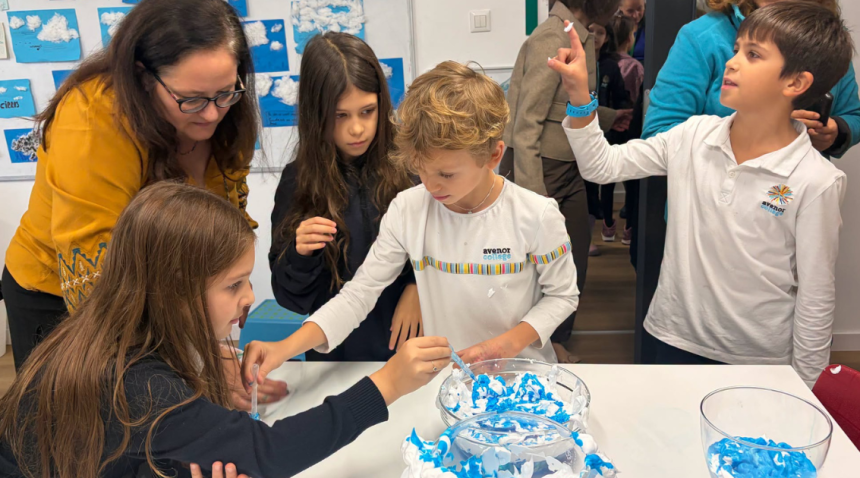
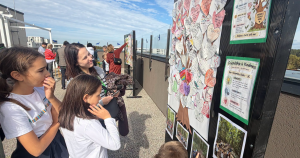
At Avenor, this was the starting question for 3rd-grade students in a six-week project. They built weather instruments, analyzed real weather data, and prepared bilingual weather forecasts, presented in their very own mini weather station. And during the Autumn Bazaar event, parents were able to discover the results of this exploration.
Behind the children’s presentations lies a question that constantly occupies us as teachers and matters just as much to parents: how do we help children use what they learn when they encounter a new situation?
A child may know a definition and still need support to recognize the phenomenon in the world around them. They may perform a calculation correctly, but not immediately identify when it is useful. The connection between knowledge and its application needs to be built and practiced. Project-Based Learning (PBL) provides us with the framework to do this.
We start from a question worth exploring, connected to the children’s reality, and build a path of inquiry around it. Over six to eight weeks, students observe, search for information, experiment, discuss, and revise their ideas. At the end, they use what they have learned to create a product that they present to parents during a dedicated event.
The project builds up throughout the learning process, alongside the children’s understanding. To prepare a weather forecast, for example, students must understand the phenomena they are describing, interpret data, and choose how to communicate it. Science, mathematics, and foreign languages become resources they use together for a clear purpose.
This is the transdisciplinary dimension of PBL: a question is explored from multiple perspectives, and children learn to make connections across disciplines. In everyday life, the situations we encounter often require this exact ability.
At the Autumn Bazaar, the same principle took different forms, tailored to the students’ age and interests.
For preparatory class children, who are at the beginning of their school life, the question was “What makes school feel like home?”. Exploring the emotions associated with a new beginning led to the creation of shadow theaters, bringing together concepts from environmental study, arts, and personal development. The project offered them a context to talk about what they feel and express those feelings through their own creation.
1st-grade students started with the question “How can we make trees happy?”. They explored the forest near the school and, inspired by Shel Silverstein’s story The Giving Tree, reconstructed the parts of a plant using natural materials. They tracked the germination of bean and lentil seeds, discovering the conditions plants need to grow. Care for the environment thus gained a concrete meaning, tied to what they could observe and do themselves.
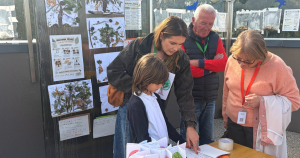
4th-grade students explored the question “How is the forest protected in a developing neighborhood?”, studying the Băneasa Forest. In the “Square of Life” project, they investigated a section of the forest from the perspective of a botanist, nature photographer, wildlife observer, ecologist, and forester, applying knowledge about environmental adaptation, life cycles, and food chains.
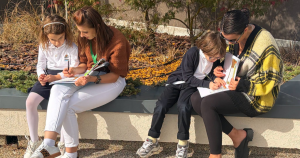
In all these experiences, children’s curiosity plays a genuine role in the direction of the exploration. They can propose ideas, choose resources or working methods, and collaborate even with students from parallel classes. They learn to justify their choices, listen to another perspective, and find a common ground when opinions differ.
The teacher’s role is essential. In the team coordinating PBL, we plan together the learning objectives and the contexts in which they can be achieved. We track what the children understand, where they encounter difficulties, and when they need explanations, practice, or a prompt to take them further. We adapt the path according to their discoveries while keeping the learning direction clear.
For parents, the final presentation makes a portion of this process visible. At the Autumn Bazaar, they were also involved in exploration stations conducted in English, featuring games that required children to apply the studied concepts in new contexts. It is a valuable opportunity to observe how a child explains what they know and how they adapt their response when the challenge changes.
Assessment evaluates both the final product and the understanding it makes visible. What matters is what the student can explain, how they use the information, and how they support their choices. And the conclusion of the project always includes reflection: what worked, what could we do differently, and what do we want to improve next time?
Parents can continue this conversation at home as well. “How did you arrive at this idea?”, “What did you change along the way?”, or “Where else could you use what you discovered?” are questions that help children understand their own learning process.
At Avenor, we seek to build such opportunities intentionally and consistently. For us, innovation in education is reflected in how we design learning: relevant questions, cross-disciplinary connections, taking ownership of choices, and contexts where knowledge can be put to work.
The impact consolidates over time. We see it when a child recognizes something they have learned in a new situation, when they verify an assumption, or when they propose a solution and can explain why it would work. At that point, what they learned at school becomes a resource they can use in their life.
If you are currently exploring school options for your child, we invite you to get to know us during a visit to Avenor College and discover how learning comes alive through questions, exploration, and projects that help children understand the world around them.
Author: Mari Nicolae – Primary School Teacher and Academic Learning Lead at Avenor