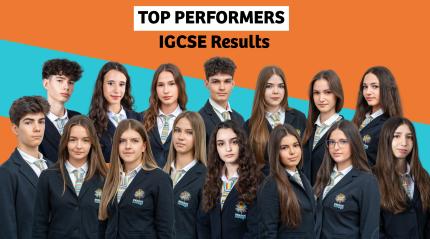
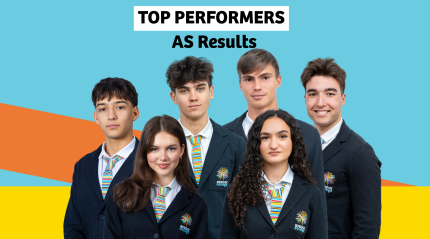
The Class of 2026 achieved the best Cambridge A Level results in Avenor College’s history. For the 40 graduates, academic achievement is now translating into opportunities: admission to top universities in the UK and Europe, competitive programmes across a wide range of fields, and the opportunity to continue their studies in eight different countries.
The results reflect a generation that has raised the academic bar at Avenor, with eight graduates achieving straight As and A*s.


For them, and for the entire cohort, A Level results are not an endpoint, but the beginning of a new chapter: access to top universities, the opportunity to choose the fields they want to specialise in and, above all, the freedom to shape their own path.
Achievement that opens the door to the world’s leading universities


One of the most relevant outcomes for this cohort can be seen in the universities its graduates have chosen for the next stage of their academic journey. All Avenor graduates who chose to study in the UK were admitted to Russell Group universities or other leading UK universities.
Their destinations include the University of Bristol, King’s College London and Queen Mary University of London. The programmes they have chosen are as diverse as their interests: Film and Television, History, History and International Relations, History and Modern Languages with a Year Abroad, and Culture, Media & Creative Industries.
They are joined by the University of St Andrews in Scotland, where one of the Class of 2026 graduates will study Comparative Literature and Philosophy.
As a result, every Class of 2026 graduate who chose the UK will continue their studies in a university environment recognised for academic excellence and research.
But the cohort’s European journey does not end in the United Kingdom.
Four graduates are building their future in engineering in Eindhoven

 For four Class of 2026 graduates, the next chapter begins in the Netherlands, at Eindhoven University of Technology (TU/e), a university internationally recognised for its programmes in science, technology and engineering and a member of 4TU.Federation, the alliance of Dutch technical universities.
Tudor and Ileana will study Electrical Engineering, Maxim Mechanical Engineering, and Vlad Computer Science and Engineering. These are fields at the heart of technological development, spanning electrical systems and mechanical engineering to computer science and digital innovation.
At TU/e, engineering education is closely connected to research and the application of knowledge in real-world contexts. The university emphasises innovation, collaboration and Challenge-Based Learning, an approach that encourages students to find solutions to complex technical and societal challenges.
The choices of these four graduates are part of a broader trend within the cohort: seven Class of 2026 graduates are pursuing Science & Technology, choosing fields where analytical thinking, creativity and problem-solving meet the technologies shaping the future.
Business, Finance & Economics – the cohort’s most popular choice
Business, Finance & Economics is the field chosen by the largest number of Class of 2026 graduates: 14 of the 40 graduates will continue their university studies in this area, across programmes and universities that reflect the diversity of their interests.
Three graduates will study at Bocconi University, one of Europe’s leading universities for business and economics, in programmes including International Economics and Finance, International Economics and Management, and Economics, Management and Computer Science. Another five have received firm offers from IE University in Spain, for programmes such as Law, Business Administration, Economics and International Relations, and Economics.
The diversity of their choices is evident even within the same field: economics and business intersect with technology, law and international relations, as graduates build different university pathways based on their individual interests and aspirations.
Another important field for this cohort is Medicine, chosen by six graduates. Four of those who applied have already been admitted to their target universities, including Humanitas University, where they will study Medicine and Surgery and Biomedical Engineering. For the other two, the admissions processes in Ireland and Italy are yet to open.
One cohort, many fields
Taken as a whole, the distribution of university choices shows just how different the paths Class of 2026 graduates are embarking on.
Of the 40 graduates, 14 have chosen Finance, Economics & Business, 10 are pursuing Law, Psychology & Humanities, 7 are heading into Science & Technology, 6 into Medicine, and 3 into Creative Arts.
It is a generation that cannot be defined by a single area of interest. Within the same cohort are future economists and entrepreneurs, engineers and technology specialists, doctors, lawyers, researchers and creative industry professionals.
Some of the choices are themselves combinations of different fields. For example, Economics, Management and Computer Science brings together business and technology, while programmes such as History and International Relations or History and Modern Languages combine disciplines from different areas of the humanities.
This variety is one of the defining characteristics of Class of 2026: academic achievement has not led to a single model of success, but has created space for very different paths.
The freedom to choose, the responsibility to excel
Beyond the universities and programmes chosen by Class of 2026 graduates, these results also say something about their journey through secondary school. The Cambridge A Level programme has given them the freedom to pursue the subjects that interest them most and to build an academic profile aligned with their passions, strengths and plans for the future.
This freedom, however, comes with the responsibility to make choices, work consistently and pursue their ambitions. Their results are not simply the outcome of an educational system that offers choice, but also of each student’s sustained effort, discipline and ability to turn their interests into goals worth working towards.
Teachers play an essential role in this journey: they help students discover their strengths, challenge them to go beyond their limits and provide the feedback they need to progress. Together with the support of families and each student’s own commitment, this partnership creates the conditions in which potential can become achievement.
And the results can now be seen in the opportunities available to them: top universities in the United Kingdom, Italy, the Netherlands, Spain, Ireland, France, Greece and Romania, as well as academic pathways spanning fields from engineering, computer science and economics to medicine, law, history and the creative industries.
Perhaps this is the most relevant picture of Class of 2026: a generation that has achieved exceptional academic results and, at the same time, found its own directions. Because achievement is not about following a single path, but about having the freedom to choose the right one and the responsibility to pursue it with perseverance.
Congratulations, Class of 2026! We are proud of you and of the standard of excellence you have set at Avenor.