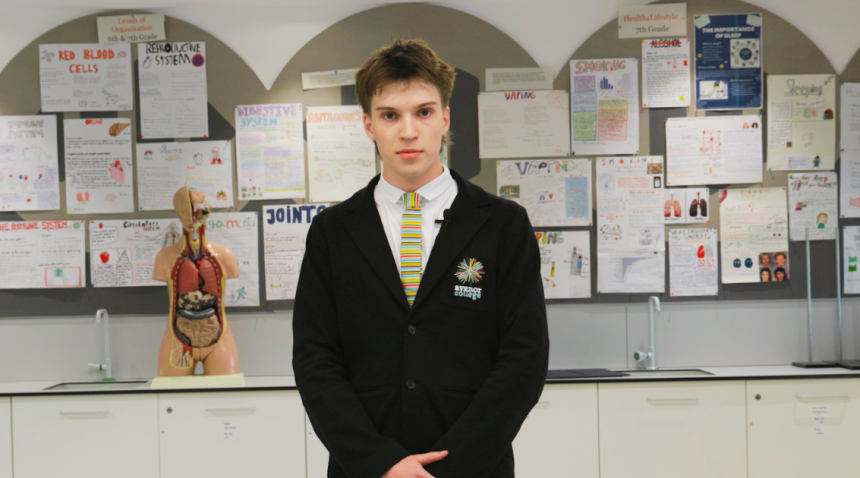
In the beginning, at school, Horia simply did what was asked of him. He wasn’t necessarily the child seeking extra activities or opportunities beyond the standard school curriculum. Over time, however, something changed. He began saying “yes” to projects, asking more questions, looking for answers beyond what was taught in class, and testing his own choices.
Years later, he graduated from Avenor High School with exceptional A Level results: A* in Chemistry, A* in Mathematics, A* in Economics, and A in Biology, alongside a clear direction for his next chapter: he will study medicine at a top university in Italy.
Looking back, Horia doesn’t speak of a single defining moment that changed his path, but rather a series of experiences that, put together, helped him become more curious, independent, and confident in his choices.
„“When I was younger, I wasn’t particularly involved in activities that required extra effort beyond what was already required at school. But over time, I discovered new opportunities that showed me there is much more to learn from school than just what is mandatory. This is the mindset I try to carry forward in life.” ”
The First Step: Saying “Yes” to Things Nobody Asked For
One of the experiences that marked this shift was his involvement in student-led projects. The 24h Business Challenge, a project coordinated entirely by students, took him out of his usual role as a participant in school activities and gave him the responsibility of building a project alongside his peers.
„“The 24h Business Challenge wasn’t just a competition; it was an opportunity for growth, both for participants and organizers. We developed essential business skills, learned to work under pressure, and collaborated with inspiring experts,” says Horia.
These types of experiences gradually taught him to look beyond the answers he was already finding in class. That is how he learned to ask questions, delve deeper, and follow his curiosity—skills that would prove invaluable as he began building his path toward medicine.
When Questions Become Part of Learning
Teachers played a vital role in this transformation. For Horia, his relationship with them wasn’t limited to classroom lessons; it extended to the questions he had and his desire to explore topics of interest in greater depth.
„The teachers made an essential contribution to my results—not only through the lessons they taught, but also through their enthusiasm in answering all my questions and their encouragement to seek more information and delve deeper into subjects beyond what we learned in class. ”
It is a change that isn’t necessarily visible in a grade book. It shows how a student begins independently searching for the next question and the next answer. This autonomy would become especially important when Horia started shaping his journey toward medicine.
From Family Influence to a Personal Choice
For Horia, medicine was always an option.
“For me, medicine was always a clear path—initially influenced, perhaps, by my father, who is a doctor—but over time, that influence gradually turned into a calling.”
Thus, medicine was a direction present early on in Horia’s journey. During his high school years, his experiences helped him explore it, understand it better, and ultimately confirm it as his choice for the future.
When it came to A Levels, selecting subjects felt natural for someone aiming for Medicine: Biology, Chemistry, and Mathematics. Yet Horia also chose Economics, a discipline not directly tied to his career path.
„“Pursuing the path of medicine made my A Level choices—namely Biology, Mathematics, and Chemistry—fairly straightforward. However, I chose to study Economics as well to gain a broader understanding of the global economic situation and the changes it drives. .”
The results came at the end of this journey: A* in Chemistry, A* in Mathematics, A* in Economics, and A in Biology.
However, choosing a university wasn’t as clear-cut from the start for Horia.
„“Even though I always knew I wanted to study medicine, it wasn’t until recently that I decided which university to attend. I can’t say I had a fully formed plan at first; I mostly knew I wanted to study at a top university. The search began with universities across Europe and materialized in 12th grade around an option in Milan, Italy. .”
To See Before You Choose
Another important step was the internship program, which gave him the opportunity to get closer to the profession he envisioned for his future.
For a student who knows he wants to study medicine, but doesn’t yet know exactly what life after university will look like, practical experience can reveal things that a list of universities simply cannot.
„“I think the internship program at Avenor helped convince me that this is the path I want to follow. For me, it was very important to have the opportunity to explore my target profession before making the step to university. .”
That is how Horia’s choice took shape: not as a rigid plan set in childhood and followed without deviation, but as a direction tested and confirmed over time.
“The road will be long, but don’t give up.”
If he could go back to the beginning of his 16s and speak to young Horia, the first thing he would tell him is not to rush.
“First, I would tell him that he is about to embark on a long journey, which, paradoxically, will pass quickly. Besides that, I would tell him to get involved in as many projects as possible from a young age, because that is the only way he will discover both what he likes and the things he isn’t suited for.
I would also tell him that he will face quite a few obstacles along the way, but not to give up when times get tough, because only after the hard times will he come across the most beautiful moments.”